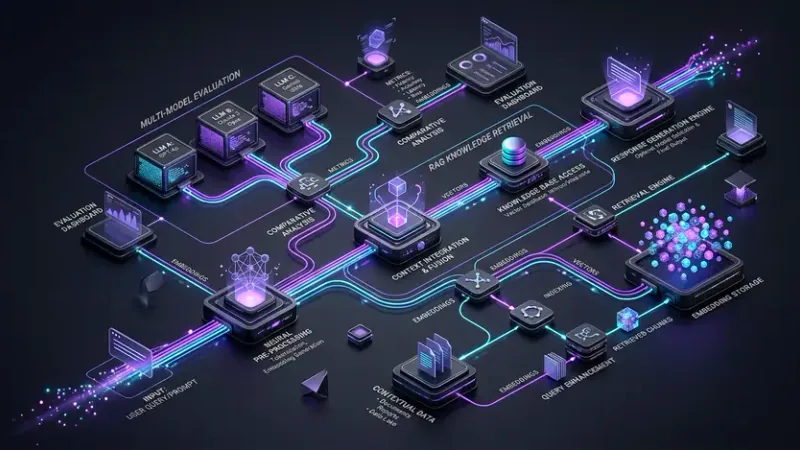
RAG Architecture (Retrieval-Augmented Generation): Connecting Documents to Language Models
A step-by-step RAG guide: chunking, embeddings, vector stores, hybrid retrieval, and evaluation with LangChain.
Key Takeaways & Executive Summary for Leaders & Engineers
- RAG tames hallucination by grounding the model in real organizational documents.
- Semantic chunking with 10–20% overlap improves retrieval.
- Hybrid retrieval (vector + keyword) plus reranking raises accuracy.
- Evaluation with Faithfulness and Answer Relevance makes quality measurable.
Table of Contents
What Is RAG?
RAG forces the model to retrieve relevant documents before answering and to ground its response in them. This "grounding" cuts hallucination dramatically.
The 6-Step Pipeline
- Chunking: 400–800 tokens with 10–20% overlap, respecting paragraph boundaries.
- Embedding: converting chunks into semantic vectors.
- Storage: inserting into a vector DB (e.g., pgvector/Qdrant) with metadata.
- Retrieval: hybrid vector + BM25 search with reranking.
- Grounding: injecting top chunks into context with citations.
- Generation: answering with sources — and saying "I don't know" when sources are thin.
RAG Prompt Pattern
<context>{{retrieved_chunks}}</context>
Question: {{user_question}}
Answer only from context. Cite chunk ids. If insufficient, say: "INSUFFICIENT_CONTEXT".
Evaluation
Two key metrics: faithfulness to sources and answer relevance. Run a 50-question golden set weekly and track regressions.
Frequently Asked Questions (FAQ)
How does RAG differ from fine-tuning?
RAG keeps knowledge outside the model and updates it cheaply; fine-tuning writes knowledge into weights. For changing documents, RAG is cheaper and fresher.
Which embedding works best?
Multilingual embeddings with strong language support. Benchmark on your own data and build chunks with overlap.
Looking to dive deeper into applied AI engineering?
In the AI-1 Masterclass, master advanced prompt architectures, multi-agent swarms, RAG, and local LLM deployment through hands-on industrial projects.
Explore the full curriculumAbout the Instructor & Author: Dr. Abootaleb Moradi
AI systems researcher, university lecturer, and designer of advanced prompt engineering and agentic workflows. For enterprise consulting and collaboration, connect via Telegram or email.